
Why China Built a Train Station as Big as a City
- Youtube Views 1,878,673 VIDEO VIEWS

22 April 2026
Video hosted by Fred Mills. This video contains paid promotion for Attio.
IN the same way your local chip shop chain can’t be compared to the scale of McDonalds, and the bus stop around the corner is in a slightly different league to L.A.X... no other train station lives up to the ludicrous size of Chongqing East.
Spread across 1.22 million square metres, China’s new high-speed rail hub is absolutely enormous.
That’s six times bigger than Grand Central in New York. Nearly 15 times larger than Europe’s grandest train station, Leipzig Hauptbahnhof. And, close to three times the size of Nagoya Station in Japan, once recognised as the world’s largest train hub. If stations aren’t your scale-barometer of choice, Chongqing East covers a space vaster than 170 football pitches, and more than two Vatican Cities.
But the significance of this transport hub reaches far beyond its staggering dimensions. This might just be the most important step in China’s infrastructure revolution so far.

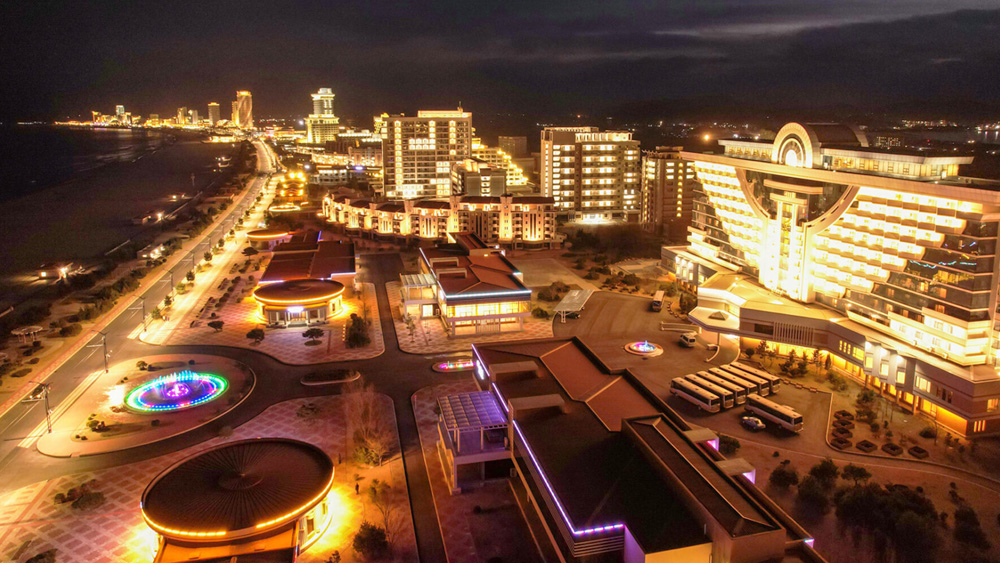
Above: Chongqing East is the world's biggest train station, covering 1.22 million square metres across its eight levels. Image: Reporterfy.
China's infrastructure mission
Before delving further into China's new mega-station, it's worth reflecting on the country itself. Because it is huge.
The nation has highways that stretch twice the length of the United States. It features more than a million bridges, thousands of kilometres of tunnels, and the largest high-speed rail network on the planet. And that network stretches beyond 50,000 kilometres. Comparatively, the country with the second most high-speed rail is Spain, with between 3,000 and 4,000 kilometres.
But this is by meticulous design. It's all part of an infrastructure mission the People’s Republic has embarked on for the last 30 years. There are multiple reasons China is throwing the kitchen sink at its infrastructure starting with symbolism. When any nation - not just China - searches for world records or makes a show of development, it’s likely they’re letting the rest of the world know how well they’re doing. All major nations do it.
The Belt and Road initiative is probably the biggest recent example of that. Since 2013, China has been investing billions to recreate the Silk Road trade routes of the past. The idea is to foster relationships and economic ties between countries along the route. Although some in the west have debated whether China is looking to exert influence as a nice side benefit.

Above: China's spending billions of dollars to create its Belt and Road initiative, building trade routes through Asia, Africa and Europe.
Dan Wang is the author behind Breakneck: China’s Quest to Engineer the Future and he says the country's infrastructure approach is multi-pronged:
"For the Communist Party, the goals of trying to meet the needs of the people and also being a leading figure on the world stage are very much intertwined. Part of what it tries to deliver is this performance legitimacy to say, well, we really can deliver these enormous bridges or all sorts of infrastructure projects that the US and UK are not really able to do anymore. And we're able to do these things to meet the needs of the people."
China's infrastructure boom is about a lot more than putting on a show. There’s wide-scale disparity between the east and west, with the west historically being less developed and significantly poorer. In response, China launched its War on Poverty.
The aim was to better connect the entire country, to mobilise its people and therefore improve trade. As an example, the previously poor, mountainous region of Guizhou is now home to half of the world’s tallest bridges, including the record breaking Huajiang Canyon Bridge.

Above: Huajiang Canyon Bridge is the highest bridge in the world, 625 metres above the river below. Image: Glabb.
By 2021, China claims it eradicated extreme poverty by plunging a quarter of a trillion dollars into efforts. At the time, the nation defined extreme poverty as a person earning less than $2.30 per day or less than $620 per year. But, the nation's infrastructure mission is far from over.
“China is a country I call the engineering state because at various points in the recent past, the entirety of the senior leadership was made up of engineers', said Wang. "This is one of the inheritances that modern China has received from the Soviet Union.”
"They sort of treat everything as a civil engineering exercise so, part of why China has built so many roads, bridges, dams, nuclear, coal, wind, solar as well as especially homes is that the engineers really just wanna build a lot of stuff."
In short, this is what present day China does and there are a few reasons why Chongqing finds itself home to the country’s latest mega-project. It’s one of four direct-administered municipalities in the country and its south-western, near central position has placed it in the midst of a development surge.
Chongqing’s GDP has been growing faster than the likes of Beijing and its core urban population has skyrocketed up to 10 million people, which is quadruple the number of residents compared to thirty years ago. When you consider the fact that China’s population as a whole is actually declining, it’s pretty telling.
The Cyberpunk City
Chongqing goes by a few nicknames - the river city, the mountain city or the more intriguing Cyberpunk City. Residents and visitors joke that the area is built in 8D. Developed on the side of a mountain, the municipality’s topography is crazy.
Taking a train in Chongqing is like traversing a rollercoaster and usually, if your carriage was hurtling towards a block of apartments, you’d think something horrible was happening. Not here - Liziba Station cuts right through the centre of a housing block.
The area features Raffles City, the deepest train station in the world and the Kuixing Building built hundreds of metres above the ground and yet still on street level.

Above: Liziba Station sees trains cuts through the middle of an apartment block.

Above: Raffles City Chongqing is a complex of buildings featuring an eye-catching horizontal skyscraper.

Above: Hongyancun Station is the deepest train station in the world, reaching down 116 metres. Image: Junyi Lou.

Above: The view looking down from Kuixing Building's street-level.
In short, Chongqing is something else and because of its idealistic location, the city has been earmarked as the centre of China’s high-speed rail. More than three billion trips were taken on the nation’s HSR network in 2024 and so this new station had to be huge.
Building a giant
Chongqing East is positioned 20km away from the city’s downtown district and features 15 platforms serviced by 29 lines. For a station that dwarves Vatican City, 15 platforms sounds pretty conservative. After all, Grand Central in New York, although just a sixth the size, has 44 platforms and a mighty 67 tracks.
However, Chongqing East comes with a contrasting design philosophy to that of Grand Central. New York’s key train hub is really a commuter checkpoint, facilitating the get up and go spirit of the city.
There’s no high-speed rail and so the trains are generally a fair bit shorter, around the 200 metre mark, maybe stretching towards 300 metres at the top end. Chongqing East has a very different mission statement. Its seven high-speed lines allow the station to connect cities, not just neighbourhoods. The trains grow to well over 400 metres, requiring massive platforms and, in turn, slower passenger turnaround times.
But that's not to say commuters aren’t welcome. The rapid 350kmph trains might steal the show but over its eight floors, Chongqing East still operates conventional rail services, metro lines, buses, taxis and even private parking and it’s all complete with shopping and a whole host of food amenities.
It's the pilot for China’s station-city integration method: transforming high-speed rail stations into huge multi-modal hubs. The idea is to synchronise transport stops and in time fit them with hotels and full on shopping centres.
As an example of this process coming to life, if you’re heading to Chongqing Jiangbei International, the city’s key airport, you can check in for your flight at the train station on the way. You can even check your luggage in - depending on where you’re travelling onwards to.

Above: Chongqing East is constructed to function as a multi-modal hub, processing various transport types from one station. Image: Reporterfy.
Constructed on the side of a mountain, the design is inspired by the terrain, the river and the nearby trees. Before any structural work could begin, crews had to create a level foundation by cutting into the landscape to clear the soil. Deep piles followed, drilled into the ground to stabilise those foundations.
The first five levels of the building were constructed first, followed by three upper levels, all supported by reinforced concrete frames for the structural base. It’s reported that a mind-blowing two million cubic metres of concrete and 366,000 tonnes of steel made this station happen. To put that into perspective, that’s more than double the amount of concrete used for Mossyrock, one of the tallest dams in the US.
But despite the fact it was built on the side of a mountain, the most challenging aspect of the process was probably the roof, thanks to its size and design. It’s enormous, spanning 120,000 square metres and weighing 16,500 tonnes. It sits like a curved canopy, covering the structure down below with large span steel tube trusses, supported by giant 41 metre tall columns shaped like huang jue trees - the city tree of Chongqing.
Beyond the technical engineering, the station was constructed in scorching temperatures, regularly climbing to 40 degrees celsius. Cooling pipes kept concrete from cracking in the heat but the workforce required a rather more novel solution: robots.
Everything from laser-guided bots to level the site, to glass installation droids to hoist the massive 800 kilogram facade sections into place for the welding bots to then join the pipe installations. Four-wheel screed machines, fitted with China’s version of GPS, smoothed concrete for the station platforms and there were even tile-laying bots.
All of this was overseen by robots described as sentinels. Fitted with AI vision, if you weren’t wearing your hardhat or vehicles were misplaced, the sentinels would step in. Reportedly, China’s robot army tripled average work efficiency, halved labour costs and limited safety incidents by 90%.
How far can China take this?
The scale of Chongqing East Station and the speed at which it was completed - just 38 months - is no surprise. China’s so used to setting engineering records that they must be finding it a bit mundane. But the real question is, why do they do it?
The nation’s infrastructure surge properly began in the 1980s. The aim was to catch up with the development of world leading nations and become a technological super-power. At one time the country’s mission focus was giant skyscrapers, envied across the world but as Wang explains, their tall tower climb is largely at an end:
"There’s kind of a sense from the top leader that these big cities don’t need to get much larger and a lot of these supertall skyscrapers may have brought prestige in the past but the sense from Beijing is that we don’t need to build these supertall buildings. I think the focus of the country has been to build out other sectors, build out other economic zones, not give as much attention to these already big winners like Shanghai as well as Beijing."
These days, the target is infrastructure - China has more dams and bridges than anywhere else on the planet and they just keep coming. Having lived in a number of cities over a six year period, Wang tells us there’s a lot of pride amongst the population in what's being achieved but whether it’s sustainable is another question.
Take Guizhou for instance - many of the massive bridges, hidden away in the mountains, are remarkable to look at but the economic return, given the material and carbon costs, doesn’t always match up.
China’s leadership would likely argue it's about more than just money, it’s about the benefit to the villages nearby, which is admirable. However, as Wang explains, a lot of the record setting is linked to competition.
"A lot of party secretaries of provinces, municipalities, are able to advance through the ranks of the Communist Party mostly by achieving two targets. The first is generating economic growth. The second is keeping a lid on political dissent and making sure there are not too many protests or reasons to protest. The challenge with most of these party secretaries is that most people are not terribly creative in figuring out how to develop their own regions so they took a look over their shoulder at what the next guy was doing which often meant building another bridge, building a really tall skyscraper."
While China is unique in its ability to create infrastructure at mind-blowing speeds, basic economics would suggest this can’t go on forever. When you build a massive bridge or a huge train station, it’s not just the material and construction costs that matter but the maintenance too - it all comes at a fee.
"It will roll on for a while but the forces of drag will be more and more severe and it ought to stop at some point", said Wang. "China’s demographic decline is not very significant right now but in 20 years or so it will be pretty significant. China has not built super tall buildings for the very reasonable case that it’s not longer economical so between the forces of economy in the short term, demography in the longer term, the fact that a lot of local governments are already running out of money, one should expect for this construction boom to stop."
But who’s to say that’s an issue? China has already achieved multitudes in its infrastructure revolution and as with its skyscraper boom of the past, the nation may decide this cycle of development is nearing its natural end.
Although given what we know about the appetite for progression in the People’s Republic and some of the mega-projects that are currently in the works, don’t go betting against China’s ability to continue building bigger and bolder projects than we’ve ever seen before.
Attio is the AI CRM of the future. To try it yourself, and ask more from your CRM, go to 👉 Attio.
Additional footage and images: WCICO, VDE 8, Tomio344456, Daniel Dumbrill, Marc Curtis, Site Engine, 耀明 钟, Terry’s WanderLens, René, LayGTraveller, theslowlane, China News Service, FOX59 News, Glabb, Think Pods. Special thank to Reporterfy and iChongqing.
We welcome you sharing our content to inspire others, but please be nice and play by our rules.
Comments