Dubai’s $15BN Palm Island Gamble
- Youtube Views 1,059,756 VIDEO VIEWS

25 February 2026
Video narrated and hosted by Fred Mills. This video contains paid promotion for Rayon Design.
WANT to know why Dubai is back? Look to the sea.
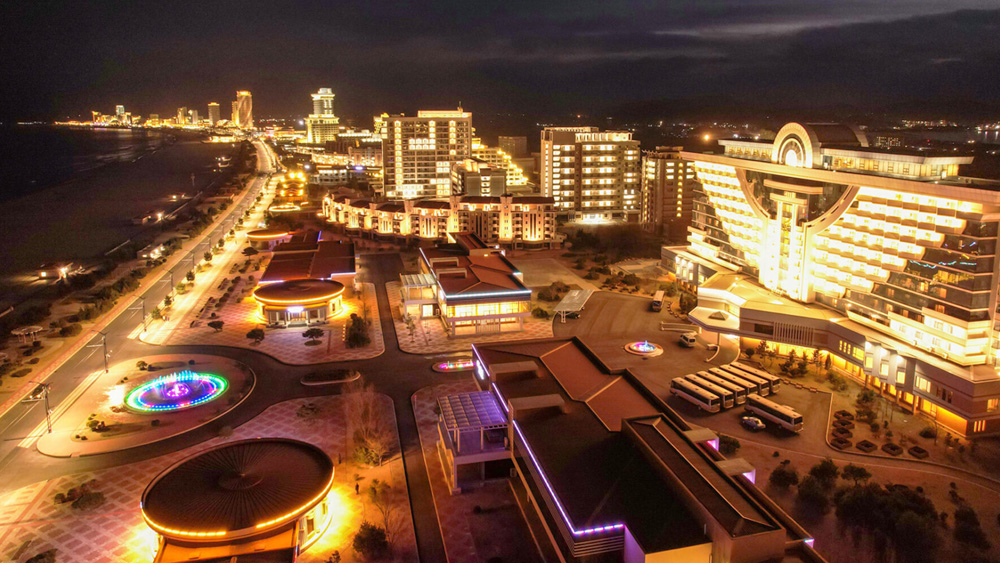
Palm Jebel Ali is the world’s largest palm-shaped island. It will have 2,000 luxury villas, 80 hotels, a sea village, a yacht club, and a mega mosque.
All in all it will more than double Dubai’s current coastline. But if you’re experiencing some severe deja vu right now, you’re not alone. Because Dubai has done this before.
This is the second time they’ve built the world’s largest palm shaped island. Only this one is bigger and bolder. After all, it is a sequel.
The first installment in this franchise was the Palm Jumeirah, back in 2007. But, suddenly, all the cranes on Dubai’s skyline froze and construction stopped overnight. Many of Dubai’s ambitious megaprojects were paused or cancelled altogether thanks to the 2008 global financial crisis.

Above: The original Palm Jumeirah.
These included a planned kilometre high skyscraper, a fully rotating supertall, and so, so many artificial islands. The 2010s were rough for the world’s glitziest oasis. But the city is now in the midst of a remarkable comeback.
Dubai is building megaprojects again. This is Dubai 2.0. But have they learned the lessons from the past, or are doomed to make the same expensive mistakes?
Dubai’s first reinvention
In the early 1990s Dubai was on the verge of its first remarkable reinvention. The city was a dusty outpost on the edge of the world. Nobody had heard of it. But all that changed with the construction of the sail shaped Burj Al Arab. A building so beautiful it didn’t just grab the world’s attention. It demanded it.
It didn’t hurt that this was also the first 7-start hotel ever built. Dubai was now no longer an outpost. It was the centre of luxury. So the city built an enormous amount of luxury real estate. And that real estate demanded one thing above all else: location, location location.
But Dubai had a problem. It was “limited” by 70 kilometres of natural coastline. Now, 70 kilometres is a lot of coastline, but not all coastlines are created equal.
The strip close to the city could fetch the best price. But over were there was less demand there was less money. So Dubai created more prime coastline close to the centre. All sorts of islands were dreamed up. There was the map of the world where you could live on your own British isle. There was the universe. And there was of course the palms, each one bigger than the last.
The first palm, Palm Jumeirah, added 50 kilometres of new coastline to Dubai. It was a phenomenal success and became an instantly recognisable global icon. Plans began immediately for the second palm. And then came 2008.
The financial crisis spread from America to the rest of the world. The Global Financial Crisis hit Dubai harder and more visibly than almost any other city outside of the West. Because Dubai depended on money pouring in from these places.
All construction across the city stopped overnight. Some property prices fell a staggering 60%. Dubai World, an investment company that manages and supervises a portfolio of businesses and projects for the Government of Dubai, asked to delay repayment on $26BN of debt. This triggered panic in global markets and the world lost faith in Dubai.
Dubai 2.0
Cut to 2026 and it’s a completely different story. Dubai is in the middle of a renaissance, and back to doing what it does best: smashing world records. This is the world’s tallest hotel. The world’s skinniest skyscraper. The world’s biggest airport. Plus two record-breaking megatall skyscrapers more than 700 metres high.
All of these projects have either been built in the last two years or are being built right now. But nothing exemplifies Dubai’s returned bombasity than the greenlighting of Palm Jebel Ali.
And that greenlight flickered on in 2023 when local authorities approved a new master plan for the site. Progress has been accelerating since then, with the palms taking shape a mini city steadily being built on top of them.
The world’s biggest palm island… again.

Above: The new palm being constructed.
So how do you build the world’s biggest palm island… again? How do you make land from scratch? You dredge it. Huge volumes of sand from the Persian Gulf seabed were transported via pipelines and dredger boats to the island site.
There, a technique called “rainbowing” sprayed the sand in a controlled arc to deposit it precisely where needed to build up the trunk and fronds of the island.
Simply placing sand on top of the seabed isn’t enough, the reclaimed ground must support the weight of all the buildings on top. Think, for a moment, of a sandcastle. It is possible to build a very large, very tall sand castle. We see it all the time.
As we know, sand is made of many little individual grains. These grains touch each other at thousands of contact points. Together they form a stable framework otherwise known as a soil skeleton.
When weight is applied on top of the sand, that weight is transmitted through these contact points from grain to grain. As each of these grains are irregular in shape they interlock, making movement harder. The roughness creates friction, which in turn also makes movement harder.
Water then fills the space in between the grains. While it doesn’t carry the weight it can sometimes add temporary strength. This is how a sand castle can be built so high.
However, in the event of any seismic activity this all goes to hell. Strong shaking causes sand grains to lose contact. Pore water pressure increases between the grains which means the water starts carrying the load instead of the sand. This is not good.
The soil loses strength and stiffness and the ground behaves like thick fluid or quicksand. Our sand castle falls to the ground. And any villa or skyscraper on top would do the same.
Even without an earthquake, liquefaction is still a serious problem for building on reclaimed land. Small movements can affect the foundations, cause buildings to tilt or crack, buckle roads, or snap underground pipes.
So how does the Palm Jebel Ali get around this problem? Well, they kind of created their own earthquake first. Engineers use a method called vibro compaction. It uses heavy vibrating probes that are inserted down through the loose sand fill, typically about 15 metres deep.

Above: The new palm dwarves the original.
The vibration, along with the injected water, rearranges and densifies the sand grains, increasing how closely they’re packed together.
Making the sand denser means more grain-to-grain contact and friction, both of which create greater stability. The whole island itself is also surrounded by a crescent-shaped rock breakwater system. This protective structure, made primarily of sand and rocks, is designed to shield the artificial island from strong tides, waves, and seasonal storms.
This particular one is approximately 17 kilometers long and about 200 metres wide, making it larger than the one for Palm Jumeirah. Construction began with marine surveying of the seabed to map depths and conditions.
Huge rock armour units were brought in, often weighing several tonnes each. These rocks were placed layer by layer over the base. A fleet of barges, tugboats, floating cranes, and dredgers transported and placed these rocks and large floating cranes lifted and set them into position.
The sloping shape of the breakwater and the graded rock layers were designed so that incoming waves lose energy progressively rather than hitting a vertical face. This reduces scour around the base and protects the reclaimed land and island interior.
Rocks were individually positioned by cranes and verified with GPS and divers, ensuring incredible precision. In fact a lot of construction of Palm Jebel Ali used GPS technology. Because the entire island was created offshore with no physical reference points like roads or fixed land boundaries, GPS was actually essential.
Engineers converted the palm design into digital coordinates. These coordinates were uploaded into differential GPS systems. Each dredger was equipped with GPS linked to the digital design and poured the sand according to this. It was almost like 3D printing an entire island.
With the land pulled up from the sea, construction could then begin on everything else: roads, utilities, sewage systems, villas, and hotels. They’re building a small city on top of the island. And that’s no easy feat.
Dubai has outdone itself and successfully a palm island that is more than twice as big as their last record breaking one. The first phase of villas have also completely sold out.
Rebuilding from the crash
So how did we get here from 2008? How was Dubai not only able to recover but start to build massive megaprojects like this again? Now bear with us, things are about to get a little complicated.
Before 2008, Dubai had a property bubble driven by cheap global credit. The sudden freeze of global liquidity after Lehman collapsed meant people from overseas were no longer buying real estate.
So Abu Dhabi bailed them out. Abu Dhabi is the other famous emirate in the UAE. And it's the one with all the cash. And why is that? Well Abu Dhabi holds 95% of the UAE’s oil reserves and 90% of its gas. Dubai’s oil reserves on the other hand are small and mostly depleted, contributing only a tiny share of its economy.
In December 2009, the government of Abu Dhabi agreed to provide $10BN to the Dubai Financial Support Fund. This money was used to meet immediate debt obligations for Dubai World as well as to help cover other obligations while longer-term debt restructuring was negotiated.

Above: Dredging has finished and villas are now being constructed on the palm.
This is the moment that changed Dubai. Forever. It set new rules for the UAE: while Dubai could innovate, it was Abu Dhabi that settled the balance sheet. The impact was evident almost immediately. Most famously, the Burj Dubai was renamed the Burj Khalifa after Abu Dhabi’s ruler.
Now, Dubai had phased development instead of simultaneous megaprojects and there was much stricter real-estate regulation to grapple with. This wasn’t an abandonment of Dubai’s crazy “build build build” mentality, it was a refinement. In a way, 2008 helped the city “grow up”.
And this paid off. Dubai is now no longer recovering but thriving. The city has re-established itself as “a neutral parking spot” for international wealth, thanks to no income taxes and fast visas.
Dubai is once again seeing international money flow in from Russia, China and Europe, which is in turn funding vast construction projects. But this time it's accompanied by a huge population boom.
While many new buildings are still essentially safety deposit boxes in the sky, there are other buildings actually being built for people to live and work in too. But, the question is: will all of this last?
Only time can answer that, but by all accounts the foundations for this new Dubai 2.0 seem to be built on sturdy ground. They’ve reinforced the sand beneath their feet, if you will.
As for the islands? Well they were built with rising seas and stronger storms in mind too. Most sea-level-rise projections for the 22nd century range from 0.3 to a metre higher. They've built a buffer for this. Combined with the crescent-shaped breakwater system, ironically this island might last longer than most coastal cities. This seems to go for the rest of the city now as well. Dubai is being built to last.
Additional footage and images: Nakheel Official, Richard Parry, CBS news, Google Earth, NBC News and Al Jeezera.
We welcome you sharing our content to inspire others, but please be nice and play by our rules.
Comments