
Why Russia Built the World's Most Remote Spaceport
- Youtube Views 524 VIDEO VIEWS

16 November 2026
Video hosted by Fred Mills. This video contains paid promotion for Brilliant.
FOR MORE than 70 years, Russia's space programme has relied on the Baikonur Cosmodrome in Kazakhstan.
It was from here that the Soviet Union launched Sputnik, the world's first artificial satellite, in 1957, and sent Yuri Gagarin into space four years later. The facility subsequently became the principal launch site for Russian crewed missions and remains an important part of the country's space infrastructure. But Baikonur has one significant disadvantage: it is no longer on Russian territory.
When the Soviet Union collapsed in 1991, Kazakhstan became an independent country, leaving Russia with a spaceport on foreign soil. Moscow subsequently agreed a long-term lease with the Kazakh government, currently costing around USD $115M a year.
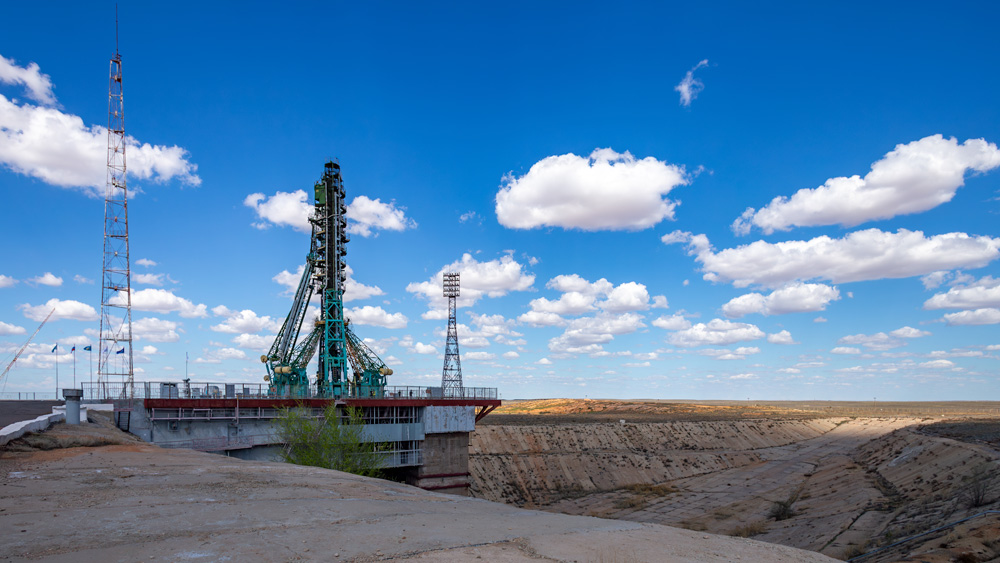
Above: The Baikonur Cosmodrome in Kazakhstan.
At the same time, the international space industry was changing rapidly. China and India were establishing themselves as major space powers, while the commercial sector was expanding through companies such as SpaceX and Blue Origin.
Russia, meanwhile, was increasingly concerned that its once prestigious space programme was losing ground. Developing a domestic launch facility became an important part of its ambitions to reassert itself as a major player in space exploration.
The plan was announced in the mid-2000s. Russia would build a completely new cosmodrome, capable of supporting its existing rocket fleet and future generations of launch vehicles. But choosing where to put it was far from straightforward.
Russia has no shortage of land, but that does not mean it has an abundance of suitable locations for a spaceport.
The position of a launch facility has a considerable influence on the types of missions it can support. The latitude determines the orbital trajectories available to rockets, while the surrounding geography must accommodate the safe disposal of discarded rocket stages.
Russia already had a domestic launch facility at Plesetsk, in the north of the country. Operational since the 1960s, it had become an important base for military and scientific satellite launches. Its northern position, however, made it less suitable for the type of missions Russia wanted to prioritise.
Rockets launched from Plesetsk typically enter polar or sun-synchronous orbits. These allow satellites to pass over the same locations on Earth at consistent local times, making them particularly useful for observation and reconnaissance.
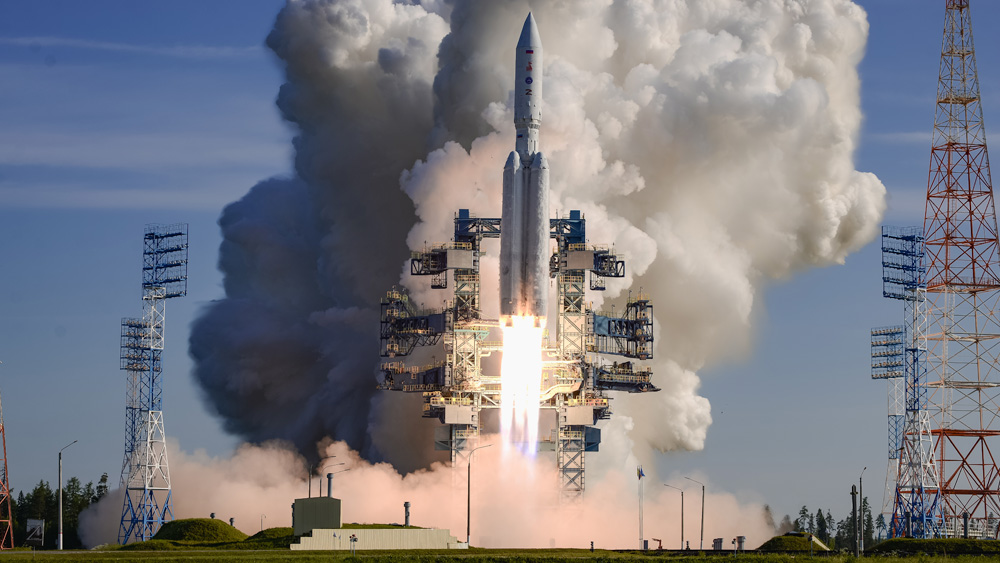
Above: The Plesetsk Cosmodrome.
Crewed missions and many communications satellites require different orbital trajectories. Reaching these efficiently generally means launching from further south. Russia therefore needed a facility closer to the latitude of Baikonur.
There was another consideration. Rockets shed their boosters and other sections during ascent, which must eventually fall back to Earth. A suitable launch corridor needs to provide large, sparsely populated areas where this debris can land without endangering communities.
Coastal locations can offer an obvious solution, with the sea providing a relatively clear drop zone. One early candidate was Vladivostok, on Russia's Pacific coast. Its geographical position was attractive, but the maritime climate brought frequent fog and unpredictable weather, creating potential problems for launch operations.
Transport connections were equally important. A modern cosmodrome would require enormous quantities of construction materials, specialist equipment and rocket components, alongside the infrastructure needed to support thousands of workers.
Eventually, the search led to Svobodny-18, a former nuclear missile installation in Russia's far east. The site offered a combination of relatively southerly latitude, inland geography, existing transport connections and access to sparsely populated territory.
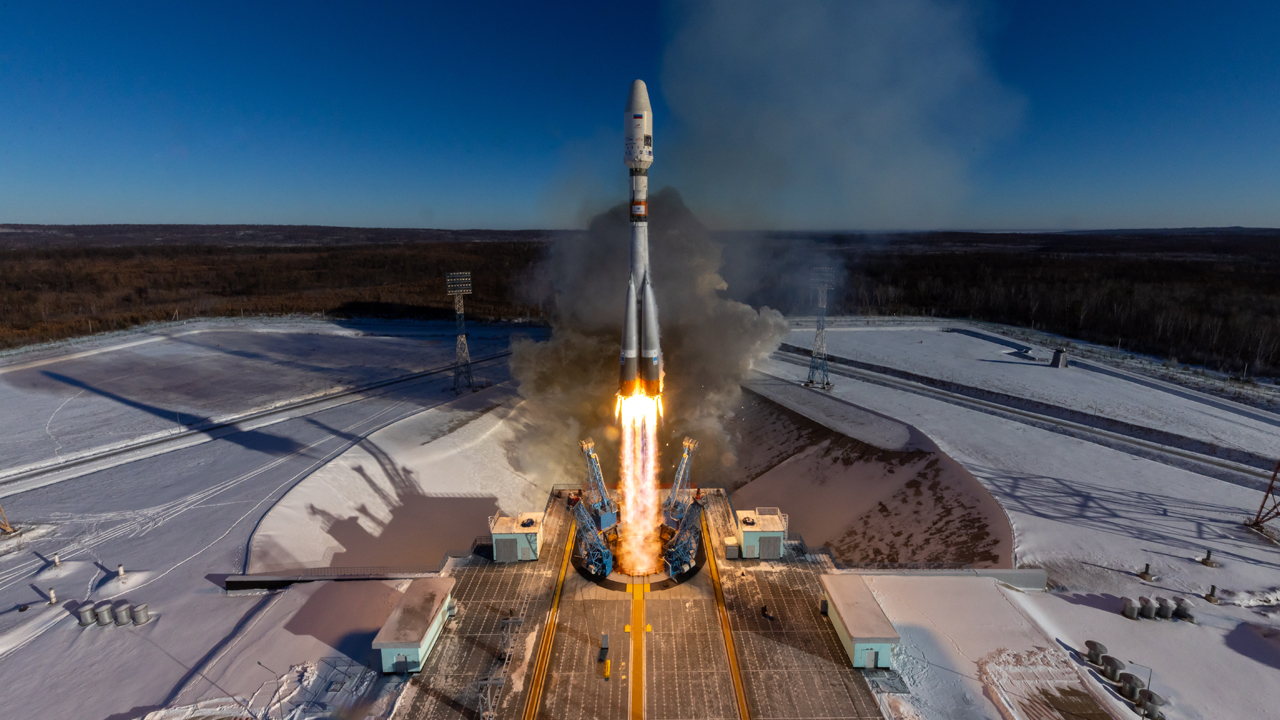
In 2007, a presidential decree authorised the development of the Vostochny Cosmodrome. The development was planned in several stages. The first phase centred on launchpad 1S, designed for the Soyuz rocket, the workhorse of the Russian space programme.
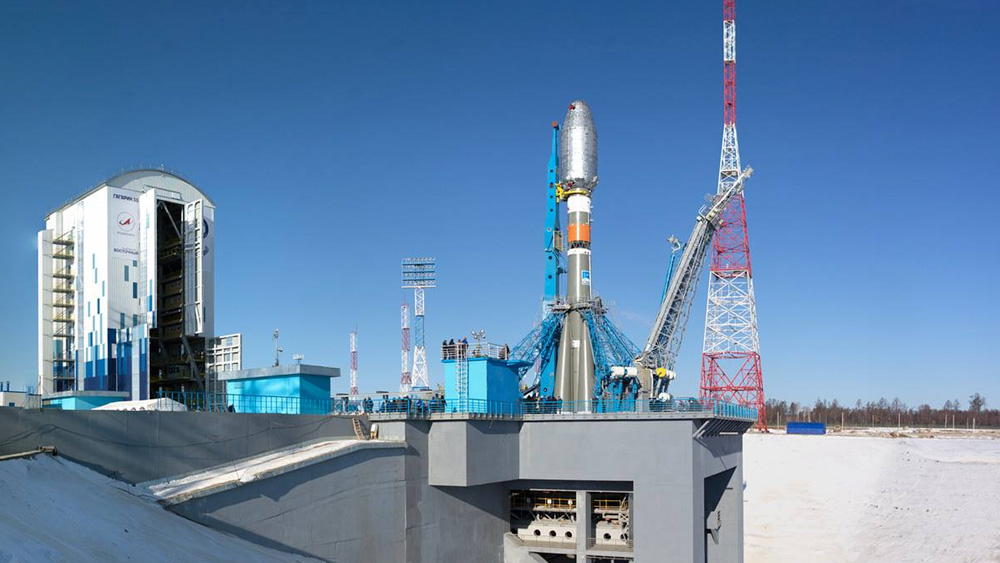
Above: A Soyuz rocket.
A second phase would introduce a separate launch complex for the Angara family of rockets, including versions capable of carrying heavier payloads. Two further launch sites were also earmarked for potential future development.
On paper, the location appeared to satisfy the major requirements. In practice, its remoteness presented an enormous construction challenge.
Vostochny lies in the Amur Oblast, beyond the Ural Mountains and the Siberian plateau. The region covers an area roughly comparable to Germany, but has a population density of just 2.1 people per square kilometre.
It is also one of Russia's less economically developed regions, with limited heavy industry and a relatively small available workforce. The nearest major city is around 200km away.
That is a difficult environment in which to construct almost any major infrastructure project, let alone a facility requiring the precision engineering and specialist equipment associated with spaceflight.
The Angara launch complex provides an indication of the scale involved. Its facilities occupy around one square kilometre, organised around a central launch platform. Beside this stands a substantial service tower, equipped with movable platforms and access structures that allow engineers to prepare and fuel the rocket.
Beneath the launch platform is a vast flame trench, excavated into the ground to channel the intense exhaust produced during liftoff.
The wider complex also includes command buildings, auxiliary structures and specialist fuel installations supplying kerosene, hydrogen, liquid oxygen and nitrogen, alongside high-pressure gases required for launch operations.
At its centre is the firing room, a reinforced control facility from which launch operations are coordinated. Every element has to work together with extraordinary precision. Yet all of it had to be constructed thousands of kilometres from the factories producing much of the equipment.
Construction of the first phase began in 2011, with the surrounding region requiring substantial investment in supporting infrastructure.
Thousands of homes were planned in the nearby settlement of Uglegorsk, which was subsequently renamed Tsiolkovsky in honour of Russian space pioneer Konstantin Tsiolkovsky.
The existing roads, originally built to serve the missile installation, needed upgrading to accommodate heavy construction traffic. Connections to the regional highway network were expanded, while tens of kilometres of new railway sidings were developed to handle deliveries.
This was particularly important because the rockets themselves were manufactured thousands of kilometres away.
Both Soyuz and Angara are transported in sections and assembled at the launch site, meaning their components must make lengthy journeys across Russia before they can be prepared for flight.
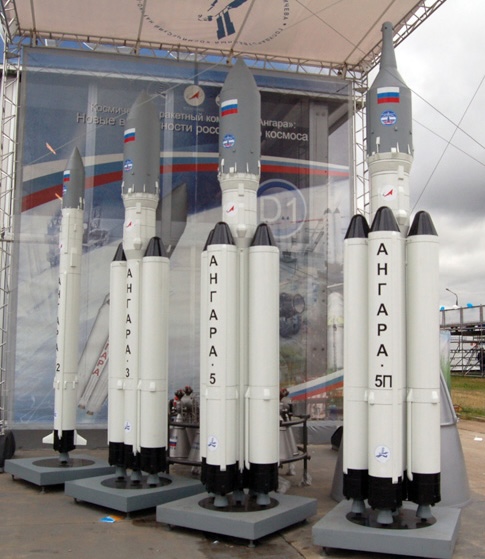
Above: Models of Angara rockets.
The Soyuz rocket is manufactured at the Progress Rocket Space Centre in Samara, in western Russia. From there, its components face a 6,600-kilometre railway journey lasting around 38 days before reaching Vostochny.
But even the railway network could not accommodate every component. The Angara launch complex required a launch table weighing around 2,000 tonnes and a 17-storey cable-fuelling tower. Both structures were too large to be transported by rail.
Instead, they were shipped by sea, undertaking a 12,000-kilometre journey through the Arctic Ocean, past the Bering Strait and along the Amur and Zeya rivers. It was an extraordinary supply chain, with some of the largest components of the project travelling almost halfway around the world before reaching the construction site. And distance was only part of the problem.
The Amur Oblast experiences some of the harshest winters in Russia, with temperatures regularly falling far below freezing and occasionally dropping beneath -50 degrees Celsius. These conditions created serious difficulties for one of the most fundamental materials in construction: concrete.
The Vostochny project required enormous quantities of the material. The Angara launch complex alone consumed approximately 291,000 cubic metres. But pouring concrete in extreme cold is a technically demanding process.
When temperatures fall too low, the water within the concrete mixture can freeze before the material has properly cured. This can disrupt the hydration process, weaken its internal structure and compromise its long-term strength.
To overcome the problem, engineers constructed enormous temporary insulated enclosures, known as thermal envelopes, over excavation areas. Industrial heaters maintained suitable temperatures inside the structures, while electrical heating coils were installed within the concrete itself to help it cure.
Even with these precautions, construction problems emerged. In 2018, inspectors discovered extensive cracking beneath the Soyuz launchpad, where sections of concrete had not been poured correctly.
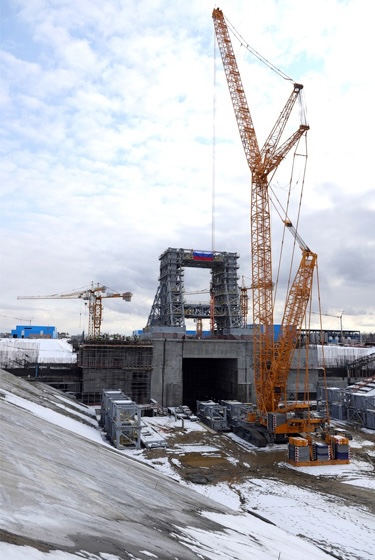
Above: Construction of the Vostochny Cosmodrome.
The defects required remedial work and added to an already difficult construction programme. But the project was also facing problems that had little to do with the weather or the remote location.
The first Soyuz launch from Vostochny had originally been scheduled for 2015. However, construction delays pushed the inaugural flight back to 2016. The project was also dogged by allegations of financial mismanagement and corruption.
In 2015, workers at the site went on hunger strike after reportedly going unpaid for several months. The dispute attracted national attention, highlighting the difficulties facing the workforce responsible for delivering one of Russia's most important infrastructure projects.
That same year, Russia's Prosecutor General reported that more than USD $126M had been stolen from the construction budget. The allegations prompted an angry response from Dmitry Rogozin, then Russia's deputy prime minister, who had responsibility for overseeing the project.
Rogozin promised to take a particularly uncompromising approach to anyone found responsible for sabotaging the development, declaring: "I will not allow sabotage, I'll simply rip heads off."
One company director subsequently found himself among those arrested on embezzlement charges. He was reportedly detained while driving a Mercedes fitted with diamond-encrusted detailing.
The controversies added another layer of difficulty to a project already struggling with construction and logistical challenges.
Meanwhile, the second phase was falling further behind schedule. The Angara launch complex had originally been expected to enter service in 2018, but construction did not begin until the following year.
Despite the setbacks, Vostochny has gradually become an operational part of Russia's space infrastructure. Its first Soyuz rocket launched successfully in April 2016, and the facility has since recorded 19 successful Soyuz launches.
The Angara programme has also progressed. Its first test flight from Vostochny took place in 2024, with the launch complex subsequently commissioned.Construction is continuing elsewhere on the site, with a third launch complex being developed for the proposed Amur rocket.
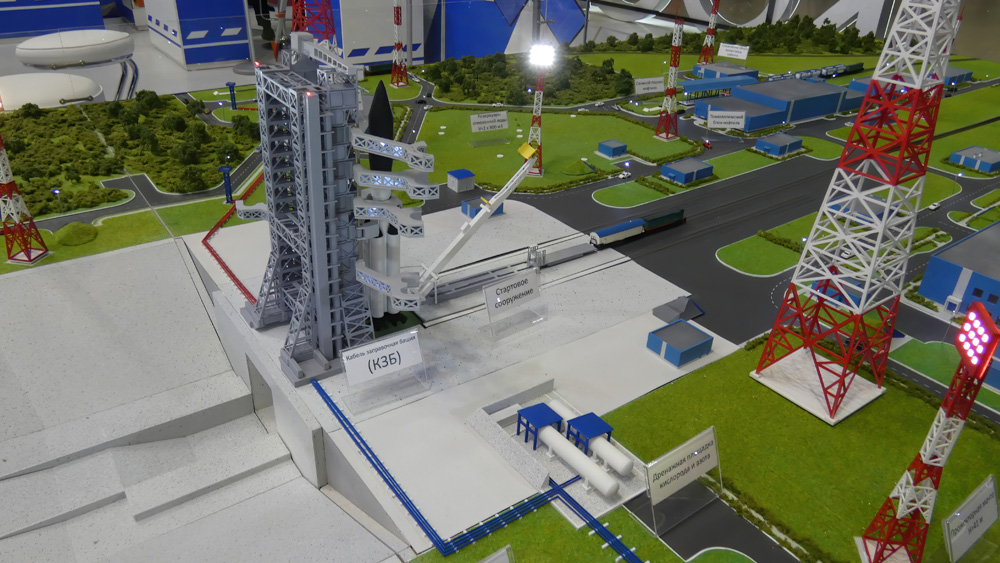
Above: A model of the Angara launchpad at the Vostochny Cosmodrome.
If successful, the Amur would introduce reusable launch capabilities to the Russian space programme, potentially helping it compete with the rapidly developing commercial launch industry.
The wider ambitions for Vostochny remain considerable. Russia envisages the facility eventually taking over a much larger share of the country's launches, reducing its dependence on Baikonur and providing a domestic base for future space exploration.
Whether it can achieve those ambitions remains to be seen. What is clear is that constructing the cosmodrome has required an extraordinary combination of civil engineering, industrial logistics and specialist aerospace infrastructure.
The project has faced freezing temperatures, enormous transportation distances, technical failures, labour disputes and allegations of corruption. Its location may have offered the right conditions for launching rockets, but it created an entirely different set of challenges for the people tasked with building it.
Space exploration is defined by enormous distances and extraordinary isolation. With Vostochny, Russia discovered that overcoming both challenges was necessary before it could even leave the ground.
Get started today for free, or upgrade to Premium for full tutoring support and unlimited access to everything on Brilliant. And right now, The B1M viewers can save 20% off an annual subscription by clicking the link here.
Additional footage and images: NASA, Roscosmos, SpaceX
We welcome you sharing our content to inspire others, but please be nice and play by our rules.
Comments